Desalination Infrastructure: Water Scarcity Solutions That Generate Yield
- Neil Robbirt

- 2 days ago
- 12 min read

The global water crisis is not a hypothetical future problem. It is a present-tense infrastructure deficit that is reshaping capital flows. In 2025, two-thirds of the world's population faces water stress — the imbalance between demand and available supply. Over 1.1 billion people lack access to safe drinking water. In the Middle East and North Africa, half of the 29 countries fall below 500 cubic metres of water per person per year, the threshold for absolute water scarcity.
Yet the investment case for desalination infrastructure has moved beyond climate altruism or development aid. Desalination is becoming a hard-asset, yield-generating alternative that combines structural demand growth, regulatory tailwinds, and contract-backed revenue. The global desalination equipment market stood at $20.0 billion in 2025 and is projected to reach $42.7 billion by 2033, representing a 10% compound annual growth rate.
The infrastructure that underpins this market — the plants, the engineering, the long-term concessions — offers yields comparable to regulated utility bonds while benefiting from dedicated government funding, PPP structures, and multi-decade demand certainty that bond markets no longer provide in traditional energy or transport infrastructure.
This piece sets out the investment case for desalination infrastructure, the specific markets driving growth, the yield mechanics that make these projects attractive, and the risks and considerations that distinguish genuine infrastructure opportunities from speculative commodity plays.
For a tailored review of how desalination infrastructure or water security investments fit your portfolio, book a consultation with our team.
Why Desalination Is Becoming Core Infrastructure, Not Supplemental
For decades, desalination was treated as a last-resort technology — expensive, energy-intensive, suitable for small island nations or wealthy Gulf states with cheap oil. That framing has become obsolete.
Three structural shifts have moved desalination from the margin to the centre of regional water supply strategies.
1. Freshwater Aquifers Are Depleting Faster Than They Recharge
The aquifers that supplied groundwater for agriculture, industry, and residential use across the Middle East, North Africa, and the American Southwest are being drained at unsustainable rates. In northern Chile, a 15-year megadrought combined with intensive mining and population growth has created demand exceeding supply by over 20 cubic metres per second. Northern regions now operate under permanent water deficit conditions, not seasonal drought. In Morocco, groundwater levels in key agricultural regions have fallen more than 30 metres in the past two decades. Desalination moves from supplemental to essential when aquifer-dependent water systems no longer function.
2. Population and Industrial Growth Are Structural, Not Cyclical
The World Bank projects that Colombia's water scarcity reduces GDP by 1.6% to 2.3% annually through agricultural collapse, employment contraction, and reduced industrial output. In Chile, copper demand is projected to double in the next decade, driving mining water consumption even higher at a moment when freshwater availability is tightening. These are not weather events that pass. They are demographic and industrial realities that will persist and worsen.
3. Regulatory Mandates Have Shifted Desalination From Optional to Mandatory
Chile enacted legislation in 2023 requiring a reduction of freshwater use in mining to 10% by 2030 and 5% by 2050. Algeria budgeted $3 billion for new desalination capacity as part of its integrated water strategy. Saudi Arabia integrated water security into Vision 2030, making desalination a national priority and a driver of government capital allocation. Morocco's National Water Plan targets 1.4 billion cubic metres per year by 2030 through a combination of desalination, reuse, and efficiency. When governments move from incentivizing desalination to mandating it, the infrastructure becomes a legal requirement rather than a discretionary investment.
The Desalination Market Is Outpacing Equity and Bond Markets
The global desalination infrastructure market is now the fastest-growing segment of water and utilities infrastructure, outpacing traditional water distribution, wastewater treatment, and even renewable energy on a regional basis.
Three growth metrics define the scale.
1. Absolute Market Expansion
The desalination equipment market is projected to grow from $20.0 billion in 2025 to $42.7 billion by 2033, representing a 10.0% CAGR. Infrastructure capital spending — the construction, operation, and maintenance of plants — is larger still. In the Middle East and North Africa, annual funding needs reach $6.3 to $7.2 billion in capital expenditure and $5.4 to $6.7 billion in operating expenditure through 2029. This is not a speculative allocation. It is committed government and private spending in response to legal mandate and physical necessity.
2. Regional Growth Rates Exceed Sector Averages
Latin America's desalination capacity is growing 22.1% through 2028, with projects in Chile, Peru, Mexico, and Brazil in various stages of development. Africa is growing even faster, at 79.2% in operational desalination capacity. The Middle East and Africa combined account for 52.7% of global desalination infrastructure spending, with the fastest regional CAGR at 10.46% through 2031. These are not mature markets with low single-digit growth. These are expansion phases where undersupply is acute and regulatory response is aggressive.
3. Specific Project Pipelines Are Now Visible and Fundable
Chile has 24 operational desalination plants, 4 under construction, 11 in environmental approval process, and 11 under evaluation. Peru is tendering new water treatment plants in 2025. Paraguay is building a US$350 million water treatment and sewage network project near Asunción. Mexico has desalination projects ranging from $85 million to $350 million across Baja California Sur and other arid regions. These are not conceptual. They are in permitting, under construction, or already operational.
Why Desalination Infrastructure Generates Yield in 2026

The yield case for desalination infrastructure rests on four structural characteristics that distinguish it from traditional utility or bond markets.
The first is contract certainty. Unlike commodity infrastructure (ports, roads) or discretionary utilities (electricity distribution), desalination output is purchased under long-dated take-or-pay agreements. Governments and industrial anchors (mining companies, food processors) commit to purchasing minimum quantities at predetermined rates, de-risking the revenue stream. These are not weather-dependent or demand-cyclical. They are legal obligations backed by sovereign credit or investment-grade corporate offtakers.
The second is regulatory support. Desalination infrastructure benefits from government subsidies, concessional financing, and public-private partnership (PPP) frameworks that are unavailable to commercial infrastructure. Morocco's National Water Plan, Saudi Arabia's Vision 2030, and Chile's mandatory freshwater reduction targets all create regulatory tailwinds that translate into guaranteed revenue for operators. When a government mandates a 10% freshwater reduction, it is simultaneously creating a legally enforceable market for desalinated water.
The third is declining technology costs. The unit cost of desalinated water has fallen from $10 per cubic metre in the 1960s to below $1 per cubic metre today. This cost reduction has been driven by reverse osmosis adoption (which accounts for 80% of global desalination capacity), manufacturing scale, and renewable energy integration. Lower production costs do not reduce yields; they reduce operating leverage and risk, allowing infrastructure investors to accept lower margins in exchange for lower operational volatility.
The fourth is renewable energy pairing. Desalination plants are increasingly colocated with or powered by renewable energy systems — solar in North Africa and the Middle East, wind in coastal regions. This integration reduces energy costs, which represent 75% of operating expenditure, and qualifies projects for green bond frameworks and climate-focused capital. A desalination plant with dedicated solar capacity has lower operational risk and access to dedicated ESG-focused investor bases willing to accept lower yields for genuine climate impact.
These characteristics translate into specific yield offerings. Desalination infrastructure bonds typically offer 4-6% yields with contract-backed revenue and government backing. Water utility stocks in the sector offer 2-3.3% dividend yields with recession-proof cash flows and decades of regulatory-protected revenue. Infrastructure funds focusing on water have outperformed equity indices over the past decade while providing more stable returns than broader utility or bond indices. In a 4% interest rate environment where Treasury bonds yield 4-4.25%, these yields are competitive and come with structural growth tailwinds rather than headwinds.
For guidance on structuring desalination infrastructure exposure — whether through direct project investment, infrastructure funds, or utility equities — book a consultation with our team.
The Middle East: Mandatory Growth in the Highest-Urgency Market
The Middle East represents the largest, most mature, and highest-urgency desalination market globally. It is also the market with the deepest government commitment and longest revenue visibility.
The demand drivers are structural and accelerating.
The region faces absolute water scarcity — not shortage, but the absence of sufficient freshwater sources to meet demand at any price point. Aquifers are being drained. Groundwater tables are falling. Surface water is either absent or shared across international borders with competing claims. By 2030, desalination capacity in Middle Eastern countries is expected to nearly double as part of long-term national water security strategies. Saudi Arabia, the UAE, Egypt, and Morocco are all pursuing multi-billion-dollar desalination expansion programmes.
The revenue visibility is unmatched in global infrastructure. The World Bank estimates annual funding needs of $6.3-$7.2 billion in capital expenditure for MENA desalination through 2029, with operational expenditure of $5.4-$6.7 billion annually. These are not projections or targets. They are commitments embedded in national water plans and government budgets. Egypt commissioned the world's largest reverse osmosis desalination station. Morocco targets 1.4 billion cubic metres per year by 2030. Algeria budgeted $3 billion for new capacity as part of its economic diversification away from oil. These are government priorities with sovereign backing, not commercial ventures dependent on private sector appetite.
The investment structures are becoming more attractive. Early desalination projects were financed as sovereign development or funded directly from government budgets. Modern desalination infrastructure increasingly uses PPP models, long-dated concession agreements, and structured finance that allow private investors to hold predictable, contract-backed assets. Saudi Arabia integrated desalination into Vision 2030, creating a policy framework that attracts global infrastructure capital. The UAE's Net Zero 2050 strategy similarly positions desalination as a core long-term asset class.
The yield case is straightforward: the Middle East needs $12-14 billion annually for desalination infrastructure through 2029. That capital must come from somewhere. Governments have limited budgets. Global development banks (World Bank, African Development Bank) can finance only a portion. The gap is filled by private infrastructure investors, green bonds, and blended finance structures willing to accept 4-6% yields in exchange for contract-backed revenue, government support, and multi-decade predictability.
Latin America: The Emerging High-Growth Market With More Volatility
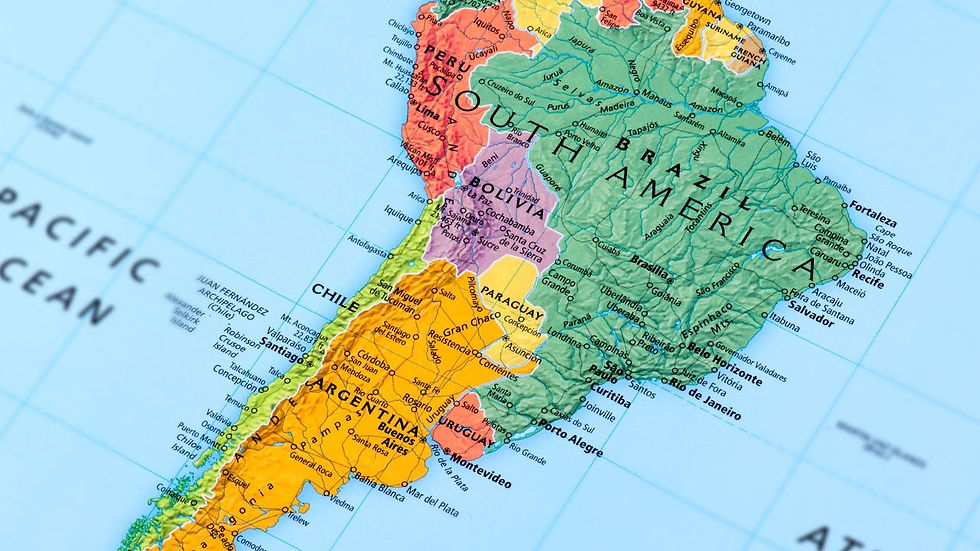
Latin America represents a different investment profile than the Middle East — higher growth rates, more diverse revenue sources, but also greater political and regulatory volatility.
The demand drivers are both acute and structural. Chile has faced a 15-year megadrought and operates under permanent water stress. Northern Chile now has demand exceeding supply by more than 20 cubic metres per second. This is not a drought that will break with rainfall. This is a structural imbalance requiring permanent desalination infrastructure. Peru, Colombia, and Mexico all face similar regional water stress driven by climate patterns, population growth, and industrial demand.
The investment scale is significant. Latin America and the Caribbean's desalination capacity is projected to grow 22.1% through 2028, reaching 5.16 million cubic metres per day. More than 40 water and sanitation projects were underway as of mid-2023, representing $9.2 billion of committed investments. Chile alone has 24 operational desalination plants with 4 under construction, 11 in environmental approval, and 11 under evaluation. These are not hypothetical projects.
The yield case is more complex than the Middle East. Latin American desalination infrastructure operates in more fragmented markets. Revenue comes from multiple offtakers — municipalities, industrial users (especially mining and agriculture), and utilities — rather than a single government anchor. Project finance structures are more complex. Regulatory environments are less stable than those in the Gulf states. Political risk, inflation risk, and currency risk are higher.
This creates both higher yields and higher volatility. Desalination infrastructure in Latin America often carries 5-7% yields to compensate for these risks, compared to 4-6% in the Middle East. For investors willing to accept currency, political, and inflation-driven volatility, Latin American desalination infrastructure offers higher income and potential capital appreciation if commodity prices (especially copper, where mining drives water demand) strengthen or if governance improves and regulatory frameworks stabilize.
The highest-growth segment is mining-linked desalination, particularly in Chile and Peru, where copper producers are mandated or incentivized to reduce freshwater consumption. Companies like Southern Copper have already deployed 235+ litres per second of desalination capacity to supply mining operations. As copper demand rises and regulatory pressure on freshwater tightens, mining-linked desalination will become a core cost centre for copper producers, creating multi-decade revenue visibility.
The Risks That Infrastructure Investors Must Price
Desalination infrastructure is not risk-free, despite the revenue certainty and government backing. Four categories of risk require careful evaluation.
1. Technology Obsolescence and Efficiency Risk
Desalination technology continues to advance. Reverse osmosis today uses 60% less energy than thermal desalination did in the 1990s. Membrane distillation techniques using solar thermal energy are now economically viable and can reduce operating costs by 30-40% versus traditional reverse osmosis. A desalination plant built today with conventional reverse osmosis technology could face significant operational cost pressures in 15-20 years if competing technologies mature faster. Long-term investors must assume incremental technology improvements that will compress margins over time, not expand them.
2. Climate-Driven Demand Variance
While desalination hedges against permanent freshwater scarcity, it does not eliminate climate variability. A year with unusual rainfall can temporarily reduce demand for desalinated water, compressing revenues even under take-or-pay agreements (which typically allow minimum purchase requirements, not maximum caps). In extreme years, demand could exceed capacity, creating supply-side vulnerability. Investors in arid regions assume baseline demand will remain stable or grow, but short-term weather volatility remains a real operational and financial risk.
3. Geopolitical and Infrastructure Risk
Desalination plants are capital-intensive facilities concentrated in arid regions, many of which face geopolitical tension. During the 2026 Middle East conflict, desalination facilities were targeted, raising the profile of geopolitical risk in water infrastructure investment. Plants in disputed border regions or conflict-adjacent areas carry an elevated risk of facility damage or operational disruption. This is a major consideration for assets in MENA, the Middle East-India corridor, and parts of Latin America.
4. Energy Cost Escalation
While desalination costs have declined, energy remains 75% of operating expenditure. A sustained rise in electricity prices — driven by grid stress, renewable energy variability, or geopolitical disruption — directly compresses infrastructure margins. Renewable energy integration reduces this risk but introduces technology-specific exposure (solar panel failures, wind variability). Investors must price structural energy cost inflation into long-term yield assumptions rather than assuming flat operating costs.
How to Access Desalination Infrastructure Returns
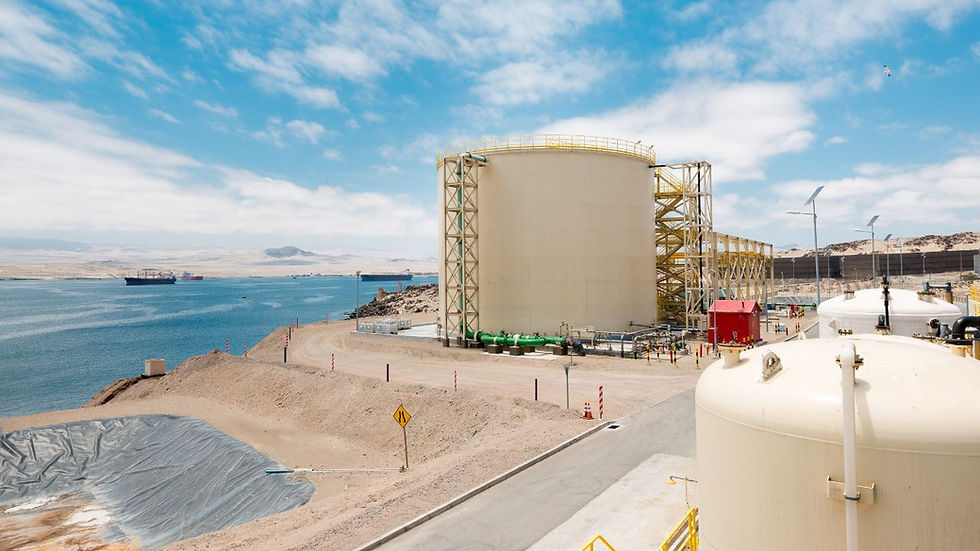
For most institutional and high-net-worth investors, direct project investment in desalination infrastructure is inaccessible — minimum commitments are typically $50-200 million, due diligence cycles are 18-24 months, and the asset class requires specialized engineering and regulatory expertise.
Alternative access points are more practical.
1. Water Utility Equities With Desalination Exposure
Consolidated Water Co. (CWCO) is the largest pure-play desalination operator, with 25.6% earnings growth forecasted for 2026 and a 1.5% dividend yield. American Water Works (AWK) is the largest regulated water and wastewater utility in the US with desalination in its portfolio, offering a $25 billion market cap, 3.30% dividend yield, and decades of regulated revenue visibility. These utilities offer stable cash flows, recession-proof demand, and exposure to structural water infrastructure growth without direct project risk.
2. Water Infrastructure and Utility ETFs
Invesco Water Resources ETF (PHO) tracks 50 of the largest water infrastructure, technology, and utility companies globally, including direct desalination operators and supporting equipment makers. €1.9 billion in assets, 0.65% expense ratio, and diversification across the US, Europe, and Asia. iShares Global Water ETF (CGW) offers similar diversification with a slightly different sector weighting. These funds provide instant diversification across geographies and operational models, reducing single-project or single-company risk.
3. Infrastructure Bonds and Green Bonds With Desalination Exposure
As desalination projects increasingly pair with renewable energy and environmental impact, green bond issuance is accelerating. Water infrastructure bonds typically offer 4-6% yields with investment-grade credit quality and contract-backed revenue. These are accessible through bond funds, brokerage platforms, or direct institutional purchase if the minimum commitment is acceptable.
4. Infrastructure Funds Specializing in Water and Utilities
Dedicated water infrastructure funds (offered by Brookfield, Macquarie, KKR, and Blackstone) provide direct or co-investment exposure to desalination and water utility assets. These typically target 6-8% distributions with access to institutional-scale desalination projects across MENA and Latin America. Minimums are typically $1 million to $10 million, making them accessible to high-net-worth investors but not retail.
The 2026 Investment Landscape for Desalination Infrastructure
Three factors are reshaping desalination infrastructure valuations in 2026.
Interest rates have stabilized at 4-4.25% for 10-year Treasuries, improving the yield attractiveness of 4-6% desalination infrastructure bonds. In 2022-2024, when Treasury yields were 2-3%, infrastructure bonds looked expensive. Today, the 4-6% yield on desalination infrastructure is competitive with bond yields while offering structural growth and inflation hedges that nominal bonds do not provide.
Political commitment to water security is unprecedented. Saudi Arabia's Vision 2030, the UAE's Net Zero 2050, Chile's freshwater reduction mandate, and Morocco's National Water Plan are not aspirational statements. They are government policies with capital allocation consequences. The billions committed to desalination represent the most stable, long-dated capital flows in global infrastructure — more durable than energy transition or transportation infrastructure.
AI data centre expansion is creating secondary demand drivers. Training large language models requires massive computational power and water for cooling. AI water consumption is projected to grow by 4.2 to 6.6 billion cubic metres by 2027. In the Middle East and North Africa, where data centre development is accelerating, this represents an unexpected, high-growth demand segment that will increase desalination volumes and extend revenue visibility.
For tailored guidance on structuring desalination infrastructure exposure — assessing project-level yields, infrastructure funds, utility equity positioning, or green bond allocation — book a consultation with our team.
The Case for Desalination Infrastructure as Core Infrastructure Allocation
Desalination infrastructure does not solve the global water crisis. Desalination is energy-intensive. It produces concentrated brine that requires careful environmental management. It is capital-intensive. It is also now the only viable technology at scale to address absolute water scarcity in arid, high-growth regions. And unlike many infrastructure plays, desalination is not dependent on commodity cycles, political winds, or discretionary public spending. It is mandated by governments facing physical water deficits and backed by multi-decade revenue agreements.
For investors seeking yield in a 4% interest rate environment, desalination infrastructure offers a structural case that is distinct from bond or equity markets. Bonds offer yield but no growth and no inflation hedge. Equities offer growth but carry valuation risk and sector-specific downside. Desalination infrastructure offers 4-6% yield, structural growth, regulatory tailwinds, and inflation linkage — an allocation profile that has become increasingly rare in 2026.
The opportunity is real. The market is growing at 10% annually. Capital requirements through 2029 exceed $12-14 billion annually. Revenue is contract-backed and government-supported. Yields are attractive relative to alternatives. Desalination infrastructure has graduated from a development-world infrastructure play to a core allocation opportunity for investors seeking yield with structural growth.
Book a consultation with our team to evaluate desalination infrastructure exposure for your portfolio, and to assess which vehicle — equities, ETFs, bonds, or infrastructure funds — fits your risk tolerance, liquidity needs, and yield requirements.
***The information above is based on World Bank reports, industry analyses from Mordor Intelligence and Grand View Research, government water plans (Saudi Vision 2030, UAE Net Zero 2050, Chile National Freshwater Policy, Morocco National Water Plan), and institutional infrastructure research current to June 2026. It is intended as analytical commentary and does not constitute investment advice. Desalination infrastructure carries material risks, including technology obsolescence, geopolitical risk, energy cost escalation, and climate variability. Investors should consult a qualified infrastructure advisor and conduct thorough due diligence before committing capital to any desalination project or infrastructure investment.