
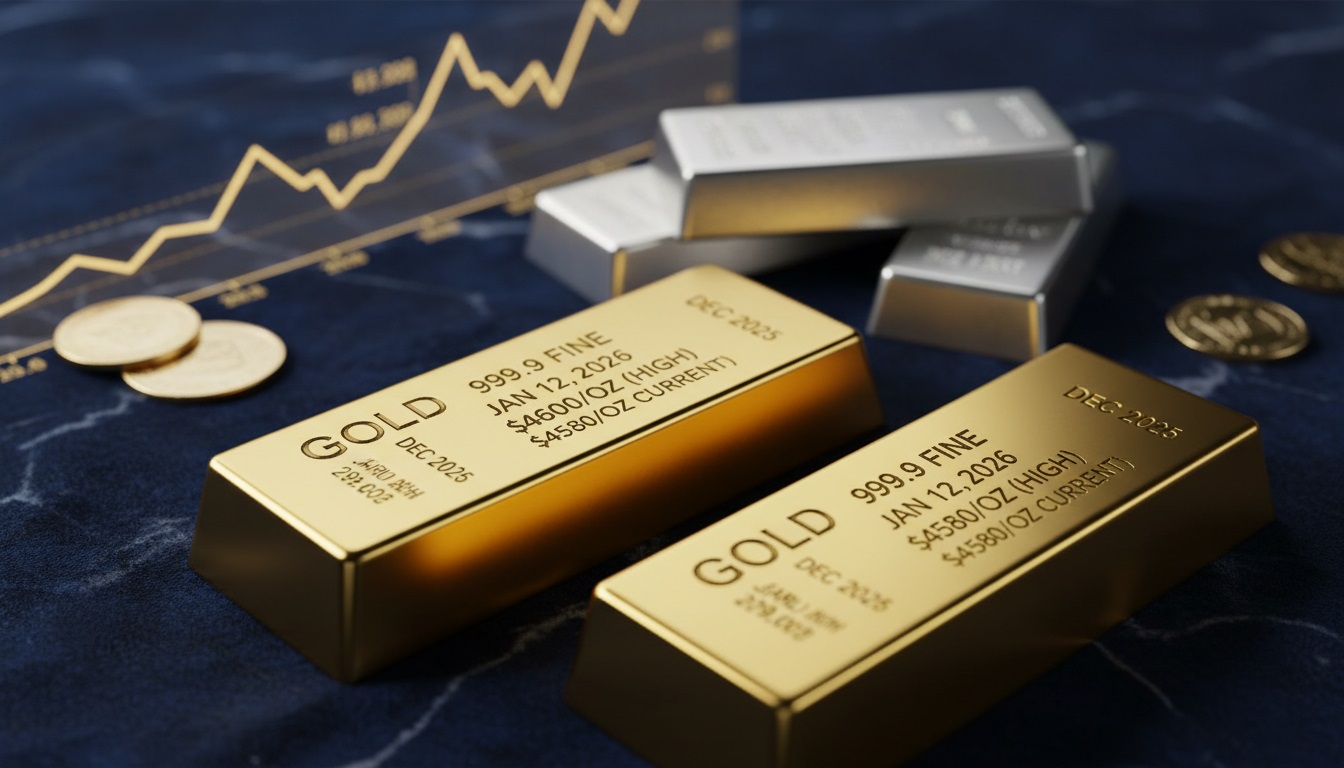
Gold and silver have entered 2026 with strong momentum, supported by geopolitical instability, monetary uncertainty, and rising demand from both institutional and industrial players.
Gold remains a cornerstone of value preservation globally, while silver’s recent performance reflects not just safe-haven interest but growing industrial relevance and supply pressures.
For investors focused on resilience and diversification, precious metals continue to offer a compelling case.
To explore how gold and silver could strengthen your portfolio, speak with our expert advisors for tailored guidance based on your goals, risk profile, and market outlook.
Market Context: Political Risk Driving Safe-Haven Demand
The geopolitical trigger that accelerated this year’s precious metals rally was the high-profile removal of Venezuelan President Nicolás Maduro. Over the first week of January, U.S. forces brought Maduro to face criminal charges on American soil, an event that immediately unsettled South American markets and cast broader doubt on regional stability.
More broadly, this event marked a significant escalation in U.S. foreign policy assertiveness. President Donald Trump’s remarks that the U.S. would “run Venezuela” during a transition period raised eyebrows across diplomatic and investment circles. Additional signals—such as** rumored military interests in Colombia** and even strategic resource acquisition talks regarding Greenland—have contributed to heightened volatility expectations.
Amid these developments, investors have rotated further into perceived safe-haven assets. While equity markets such as the S&P 500 and Dow Jones have posted record highs, the simultaneous strength of gold and silver suggests a growing investor preference for portfolio hedging alongside growth allocations.
Gold Approaches All-Time High: Key Drivers
Spot prices have been hitting new record highs, nearing and in some cases exceeding the $4,540 per troy ounce mark in late December 2025 and early January 2026. The all-time high has been reported around $4,600 per ounce. As of January 12, 2026, the spot price is fluctuating around $4,580 per troy ounce.
Several factors continue to support this trend:
1. Geopolitical Uncertainty
In addition to the crisis in Venezuela, tensions persist in Eastern Europe, the Taiwan Strait, and the Red Sea shipping lanes. These flashpoints have increased the demand for capital preservation strategies, with gold continuing to serve as a global standard for wealth protection.
2. Central Bank Purchases
According to the latest World Gold Council report, 2025 saw the second-highest level of central bank gold buying on record, surpassed only by 2022. China, India, Türkiye, and multiple Middle Eastern countries have been active accumulators, seeking to diversify reserves away from the U.S. dollar and insulate themselves from currency-based sanctions risk.
This trend appears to be continuing into 2026. Central bank demand is especially significant because it represents long-term, non-speculative capital, often placing upward pressure on prices even when retail flows decline.
3. Real Interest Rates and Currency Pressures
Although nominal interest rates remain elevated in developed markets, real yields have remained compressed due to persistent inflation, particularly in energy and food sectors. In such environments, non-yielding assets like gold tend to outperform, especially when fiat currencies experience purchasing power erosion.
The Japanese yen and several emerging market currencies have depreciated sharply against gold over the past year, reinforcing the asset’s role as a cross-border hedge against monetary dilution.
Silver Surpasses $80: Supply and Demand Rebalancing
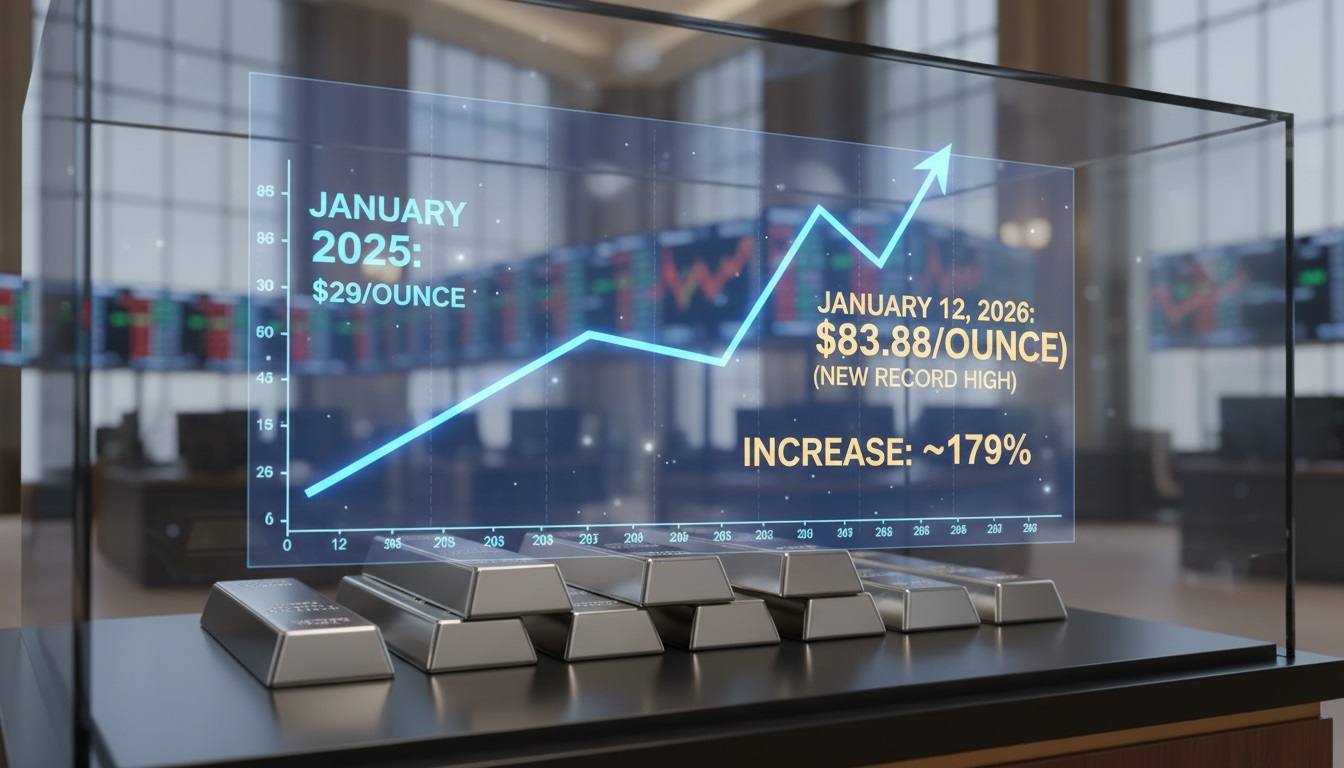
The price of silver on** January 12, 2026**, hit a record high of approximately $83.88 per ounce. This represents a significant increase of around 179% from its price a year prior (around $29 per ounce in early 2025).
Unlike gold, silver benefits from both monetary demand and robust industrial use. Its role in green energy, electronics, and automotive sectors is expanding rapidly.
1. Industrial Demand Acceleration
Silver is a critical input for photovoltaic (solar) panels, electric vehicle (EV) components, 5G infrastructure, and advanced semiconductors. According to data from The Silver Institute, industrial demand rose 15% year-over-year in 2025 and is forecast to increase by another 20% in 2026.
Much of this growth is structural, driven by long-term policy shifts toward decarbonization and electrification. Governments worldwide are subsidizing energy transition technologies, and manufacturers are facing mandated production targets for EVs and renewables—further supporting forward silver demand.
2. Structural Supply Constraints
On the supply side, global mine production has struggled to keep pace. Several major producers—including Mexico, Peru, and Bolivia—have faced political disruptions, environmental regulatory pressures, and declining ore grades. In 2025, global silver output fell approximately 6%, exacerbating an existing market deficit.
The result:** demand is now outstripping supply for the fourth consecutive year**, creating a bullish long-term foundation for prices even in the absence of new geopolitical risk.
Market Dynamics: Margin Calls and Institutional Activity
**Both gold and silver briefly pulled back in late December 2025 **following an announcement from CME Group that it was raising margin requirements on futures contracts for precious metals. This move forced some traders to liquidate or reduce leveraged positions, resulting in a short-term correction.
However, the price dip proved short-lived. Physical demand remained strong, and institutional investors—particularly commodity-focused hedge funds—used the opportunity to increase their positions.
In early** January 2026, flows into precious metals ETFs have rebounded sharply. SPDR Gold Shares (GLD) and iShares Silver Trust (SLV) have both reported multi-billion-dollar inflows in the past 10 trading sessions**. This institutional interest further reinforces the trend and points to a growing consensus that the current rally is rooted in fundamental drivers, not speculation.
Using the Gold and Silver Surge to Build Portfolio Resilience
In the current macroeconomic environment, the ongoing gold and silver surge is reinforcing the role of precious metals as an effective counterbalance to risk-on assets. While U.S. equities have continued to climb—buoyed by strong earnings and optimism about future Federal Reserve policy—investors remain wary of tail risks.
Gold and silver offer diversification benefits not only during crises but also during periods of currency volatility and global realignment. As more economies de-dollarize and central banks recalibrate reserve strategies, the strategic role of precious metals is expanding.
With gold nearing $4,540 per ounce and silver trading above $80, many investors are asking the same question: how can I benefit from this trend without overexposing myself to volatility?
Whether your objective is portfolio protection, speculative gains, or long-term wealth preservation, precious metals can play a variety of strategic roles—especially in a macro environment defined by monetary shifts, political risk, and constrained resource supply. Below, we explore how investors can approach gold and silver in 2026 with clear, actionable strategies.
If you’re considering how to balance opportunity with risk, our advisors can help you build a precious metals strategy that fits your broader investment goals. Click here to book a private consultation with our experts.
Strategic Role of Precious Metals in a Modern Portfolio

Before selecting a vehicle, it's important to define what you want gold or silver to do for your portfolio.
Common objectives include:
- Capital preservation in times of geopolitical uncertainty
- Inflation hedging when fiat currencies weaken
- Diversification from equity and fixed-income holdings
- Speculation on industrial demand and price momentum (especially in silver)
- Long-term wealth storage outside of financial system risk
Your investment approach should match your intended outcome. For example, a retiree looking for capital stability may choose physical bullion or gold ETFs, while a younger investor may look at silver mining equities or futures for upside potential.
Choosing How to Hold Gold and Silver
1. Physical Bullion (Coins and Bars)
Best for: Wealth preservation, geopolitical hedge, long-term storage
- Gold coins (e.g., American Eagles, Canadian Maple Leafs) and silver bars remain the most direct way to own precious metals.
- Physical bullion is immune to financial system risk (bank defaults, ETF liquidity freezes).
- Investors should consider secure storage: bank safety deposit boxes or third-party vault services like Brinks or Loomis.
Tips:
- Avoid collectible “numismatic” coins unless you are an expert.
- Ensure your bullion is **recognized by global markets **(LBMA-approved refiners).
2. Precious Metals ETFs
Best for: Liquidity, convenience, and tax-efficient exposure (especially within IRAs or SIPPs)
- Top gold ETFs: SPDR Gold Shares (GLD), iShares Gold Trust (IAU)
- Top silver ETFs: iShares Silver Trust (SLV), Aberdeen Standard Physical Silver Shares (SIVR)
- These ETFs are backed by physical metal and trade like stocks on major exchanges.
Tips:
- GLD and SLV are highly liquid and suitable for short- to medium-term trades.
- Investors concerned about counterparty risk should read each fund’s prospectus regarding physical redemption policies.
3. Mining Stocks and Streaming Companies
Best for: Leveraged upside to rising metal prices
- Gold and silver miners can outperform bullion in bull markets due to operating leverage.
- Major gold producers: Newmont Corporation, Barrick Gold, Agnico Eagle
- Silver-focused names: First Majestic Silver, Pan American Silver, Wheaton Precious Metals
Streaming companies like Franco-Nevada and Royal Gold provide** royalty-based exposure with lower operational risk**.
Tips:
- Focus on companies with strong balance sheets, low all-in sustaining costs (AISC), and diversified operations.
- Consider** mining-focused mutual funds** or ETFs like GDX (gold miners) and SIL (silver miners) for diversified exposure.
4. Futures and Options
Best for: Sophisticated investors seeking leverage
- Gold and silver futures offer direct exposure to metal prices with high leverage.
- CME Group contracts dominate trading volumes but require margin accounts and careful risk controls.
Tips:
- Start with micro futures (e.g., Micro Gold futures) to manage exposure.
- Use stop-loss orders and don’t overleverage—precious metals are volatile.
5. Digital Gold and Tokenized Metals
Emerging Trend:
- Several fintech platforms now offer fractional gold/silver ownership through blockchain-based tokens backed by real vault holdings.
- Providers include Paxos Gold (PAXG) and Tether Gold (XAUT).
Caution: While convenient, regulatory oversight varies. Verify custodian and redemption terms before investing.
Sample Portfolio Allocations
Precious metals allocations vary depending on risk tolerance and investment horizon. Here are sample models:
| Investor Profile | Gold Allocation | Silver Allocation | Method |
|---|---|---|---|
| Conservative Retiree | 10% | 0–2% | Bullion + Gold ETF |
| Balanced Portfolio Builder | 5–10% | 3–5% | ETFs + Streaming Stocks |
| Aggressive Speculator | 0–5% | 10–15% | Silver miners + Futures |
Note: Silver is more volatile than gold and best kept as a smaller portion unless seeking growth or speculative gains.
Key Risks to Monitor in 2026

While the structural case for gold and silver is strong, investors should remain aware of the following risks:
1. Policy Reversals
- If geopolitical tensions unexpectedly ease or the Fed adopts aggressive rate hikes, momentum could cool.
- However, given current uncertainty, a significant pullback seems less likely in the near term.
2. CME Margin Requirement Changes
- As seen in December 2025, increases in futures margin requirements can spark short-term volatility.
- Monitor announcements from CME Group and other exchanges.
3. ETF Liquidity or Redemption Clauses
- In a liquidity crisis, some ETFs may suspend physical redemption or tracking accuracy.
- Read fund documentation closely and use multiple vehicles if diversification is key.
4. Mining Sector Risks
- Resource nationalism, environmental regulations, and labor strikes can impact mining operations, especially in Latin America and Africa.
- Diversify across producers and jurisdictions when investing in equities.
Silver-Specific Considerations for 2026
1. Watch the Gold-Silver Ratio
- The long-term average is around 55:1.
- If the ratio starts widening again, silver may present renewed value relative to gold.
- As of this writing, the ratio has narrowed to ~56:1 from 90+:1 in 2022, suggesting silver’s rally may still have room to run.
2. Track Industrial Policy
- Silver demand is directly influenced by green infrastructure projects.
- The U.S. Inflation Reduction Act, EU’s Net Zero Industry Act, and China's five-year plans all support continued silver demand growth.
3. Monitor Supply Risk
- Any production slowdown in Mexico or Peru—where silver mining represents a major economic pillar—can tighten supply quickly.
- Keep an eye on environmental permitting timelines, labor disputes, and tax regime changes.
Final Thoughts: Staying Strategic with Precious Metals
**Gold and silver **aren’t just market trades—they’re enduring components of a resilient, well-balanced investment strategy. When used intentionally, they can act as a stabilizer, a diversifier, and—particularly in silver’s case—a growth engine during times of industrial transition.
In the current macro climate, with fiscal deficits rising, global diplomacy in flux, and long-term inflation risks far from resolved, a disciplined allocation to precious metals remains both rational and timely.
Whether you’re protecting family wealth, seeking asymmetric upside, or simply reducing your correlation to equity markets, the tools are available—and the case is clear.
For personalised guidance based on your objectives and risk profile, book a private consultation with our precious metals specialist team to explore how best to position your portfolio.
This article is for general information only and does not constitute financial, legal or tax advice, a personal recommendation, or an offer to buy or sell any investment. Rules, prices and regulations change; verify current requirements with a qualified adviser before acting.